

Quick Reminders
Join us for the “Saturday Celebration,” featuring Rita Mookerjee when you become a paid subscriber to this Substack.
I thought I knew how to get published, then I became a journal editor. . .
In the Triggering Town, poet Richard Hugo says that to write a poem you have to have at least “a streak of arrogance”. I admit it, I used to have a pretty thick streak. A year ago I had a streak so thick I decided to found a press.
I had gotten some poems published. Some had gotten awards. Some had even been published in a full book (When the Moon Had Antlers, Pine Row Press, 2023). I had also written plenty of poems that had gotten rejected, or been thrown (by me) into the trash. But I thought I had an overall good understanding of what it means to write a poem, to edit it, to know when it is ready to send out.
Then I founded Odd Pocket Press, and became it’s managing editor. I invited 5 poets I knew to be the readers and selectors of all the poems. While I oversaw operations, I did not get to weigh in on which poems we published. I was only an observer.
What I saw opened my eyes in ways no workshop ever could.
3 Ways to Become a Better Poet, According to an Editor (Me!)
Some things are subjective… but not all, so know your audience.
I know you’ve all heard this before. I’ve probably said it to you directly. If you submit a poem and it gets rejected it may have nothing to do with the quality of the poem and instead with the editor’s personal aesthetic. So don’t lose faith, just submit to another journal. Try to find the editors who appreciate your style or subject matter and target your work to them.
But I didn’t really get just how true this rule was until founding Odd Pocket. I told the editors that they should read all submissions and then give me their list of 10 favorites, in order. I wanted them to choose for themselves, without being influenced by one another. I figured some poems would be SOOO good that everyone would agree we had to publish them. I read all the submissions too, and picked 10 of my favorites, just for fun. (My opinion doesn’t count, but that doesn’t stop me from sharing it with everyone I know).
Then the day of truth arrived and I was shocked.
NOBODY had the same top choices. Everyone had chosen different poems as their top favorites. All of them were different from my top favorites. Why? Because everyone has different criteria for what makes a poem work. Some preferred a strong sense of form. Some wanted a poem to have casual, colloquial speech. Some wanted their poems to be strange. Some wanted them to be more accessible. Some wanted grit. Some wanted roses. Some wanted a subject matter that nobody else was talking about.
There were only a small handful of poems that had any kind of overlapping vote. These were poems that caught the eye of 2 or 3 readers, eventually. However, when it came to picking a favorite, first choice poem, everyone had different choices.
Weird wins out over cliche, so make sure your images and metaphors are fresh.
Nikki Giovanni says that if everyone agrees on what your poem means on a first reading, it may not be very good. For me, if I felt like I “got” the poem on the first read, I usually put it in the “no” pile quickly. That’s because it was usually either “telling” me something instead of “showing” me something, or it relied heavily on cliched metaphors and images. If a poem showed me something I had never seen before, or left me saying “I need to read that again to get where we are going, or to figure out how we got here,” I usually put it in the “round 2” pile.
The poems that ultimately got chosen were chosen because of their uniqueness, because they were doing something special. When you do something different like this it means it will really stand out for one person who likes that difference, and probably alienate someone who doesn’t.
Paradoxically, what made a poem move from round 2 to round 3 was not it’s strangeness, but it’s universality. I love to find a poem that requires a second reading, but if I read it a second time and a third time and still feels like I don’t get it, can’t say what it is trying to tell me or ask me, or can’t relate (because I can’t understand) then I feel cheated.
This is the interesting dynamic I talk about in workshops at The Poetry Salon all the time. You want things to surprise a reader and get them thinking new thoughts, but you also need it to make some level of sense. How you do that is always a risk. In workshop when people ask how they know they’ve hit this sweet spot, I usually tell them there is no real formula for this, which is why it’s good to have a workshop in the first place. You need a testing ground where you can reach out and ask, “Is this weird enough?” and then, “even though it’s weird, can you still understand what I am saying? Does it resonate?”
Some people make the mistake of thinking that in order to be “original” they need to learn by themselves, so they won’t be influenced by others. Dean Young (a truly original poet) says in the Art of Recklessness that this is faulty thinking. If you don’t read widely, then how do you know if what you’ve said is unique or has been said before?
This happens to me a lot in workshop. I think I’ve come up with a pretty unique metaphor, like “your eyes are green as the sea” and then somebody who is much older and more well-read than I am says, “I’m pretty sure I’ve heard that before.”
Reading lots of poems for a journal has definitely shown me which metaphors get overused and it throws the fresher ones into contrast.
Editing is everything, so get feedback from a friend or group before you submit.
Back to what I said about subjectivity here. MY personal favorites didn’t even make the list. When I asked the group why nobody chose X, Y, or Z poems, our readers said, generally, “They were good, but not ready yet. They still needed to be edited down.”
This brings me to the next point, which is that while style and subject are definitely subjective, one thing isn’t - the use of both craft and careful revision.
There were a lot of poems like that in the mix. Many that we thought had something to say, but just needed some strengthening of the craft. One specific aspect of craft that really stuck out to me, and has changed the way I edit, is the importance of that first line.
When you’re reading through so many submissions, and you are starting to go blind from so many words at once, that first line of a poem really needs to grab you! I won’t belabor the point here because I developed an entire workshop on this topic which you can see below for free.
Editing Tips for Busy Poets Rewatch Here
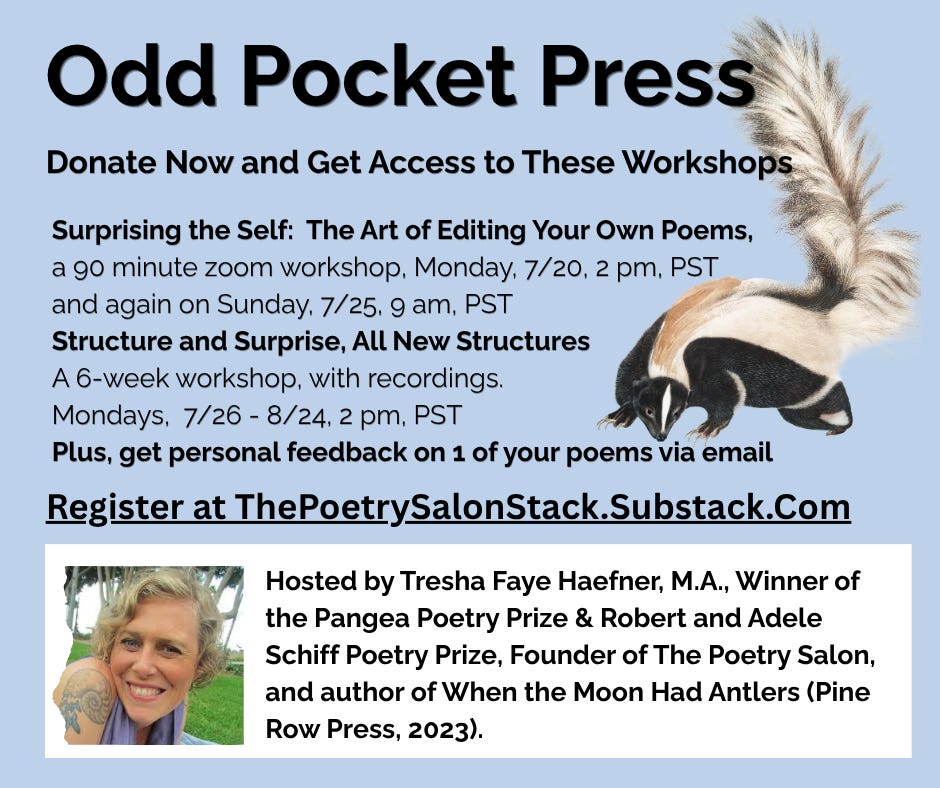
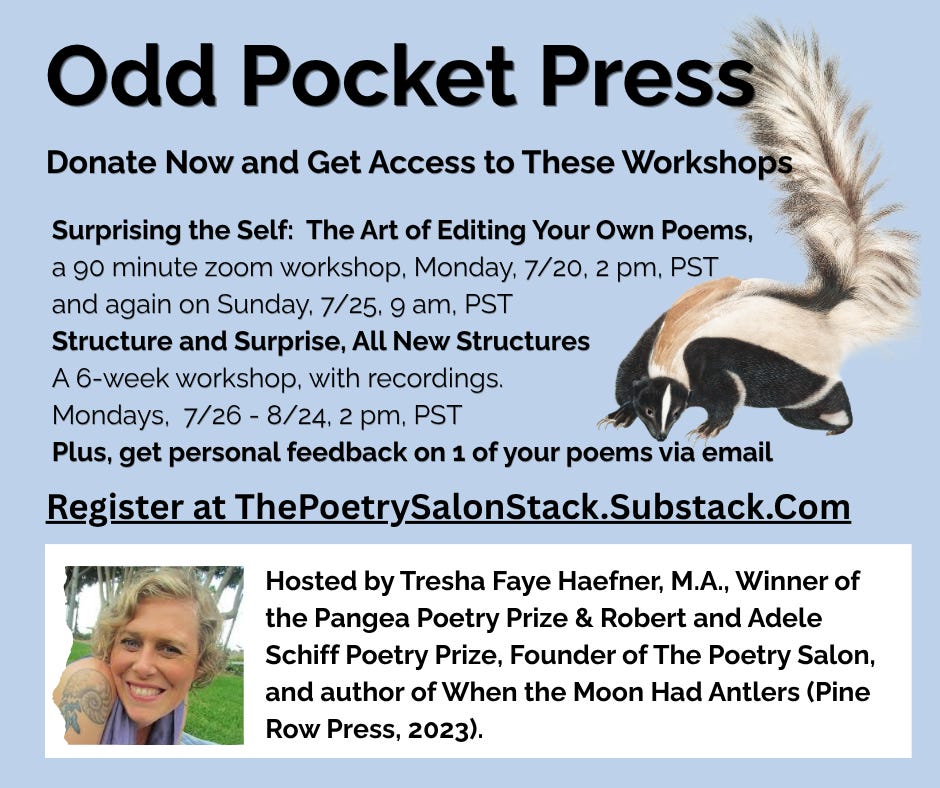
Plus, register for some of these DONATION-BASED events that will help you improve your poetry at the button below. Suggested donation for the 6-week workshop is $25 - 175. All donations help us create free events, offer partial scholarships to feedback workshops, and allow for fee-free submission periods at Odd Pocket Press. Nobody will be turned away for lack of funds. Any and all support is appreciated.
Fantastic post! I really appreciate your perspective from the other side of things!